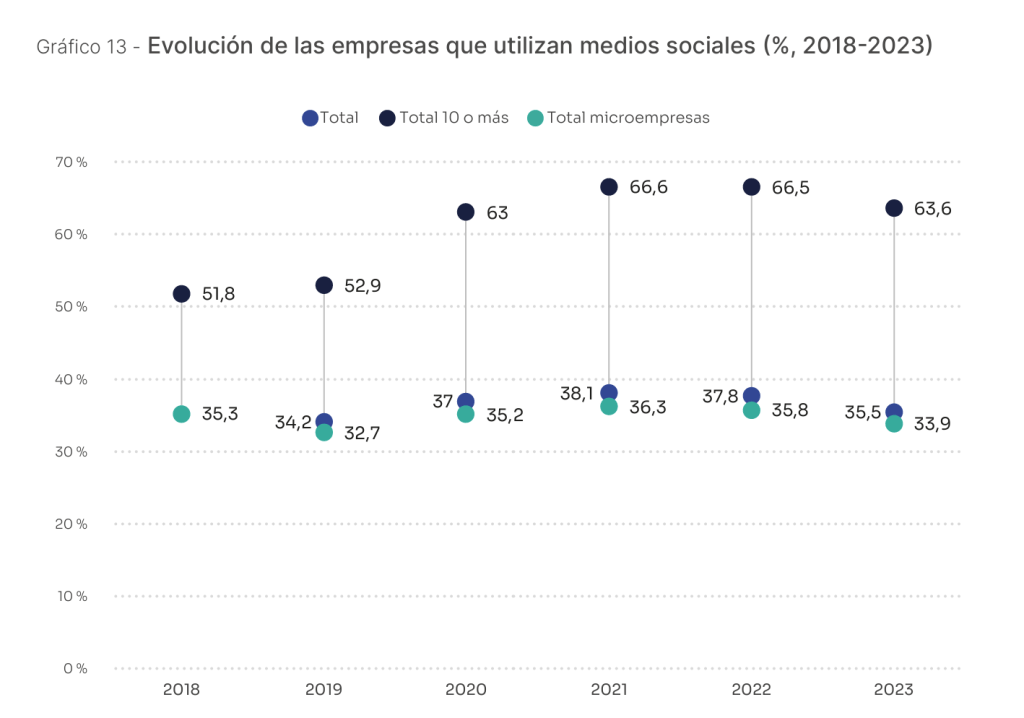
Social media usage by businesses peaked in 2021, driven by the COVID-19 pandemic, which forced interactions and sales to be digitized in record time. However, recent data from the SME Digitalization Report 2024 show a downward trend: in 2023, only 35.51% of companies in Spain used social media, marking a sustained decline since that peak. This phenomenon invites us to reflect on whether we are facing a temporary disenchantment or a more profound change in the way companies manage their digital presence.
Factors that explain disenchantment
Although social media is still a good tool for communication and marketing, I think there are several factors that have contributed to this lack of interest on the part of companies, especially smaller ones:
- Less visible results: Many micro-businesses and SMEs invest time and resources in social media in the hope of seeing a direct impact on their sales, but the results are not always tangible. This disconnect between effort and impact creates frustration and demotivation.
- Changes in algorithms: Major platforms have drastically reduced organic reach, forcing businesses to invest in advertising to be visible. This makes social media a channel perceived as expensive and less accessible for businesses with limited budgets.
- Competition and saturationWith so many brands competing for users' attention, standing out on social media has become more complicated. This especially affects small businesses, which lack the resources to consistently produce high-quality content.
- Lack of strategy: Many businesses jump into social media without a clear plan or defined goals, leading to a sense of “posting for the sake of posting” and a lack of a clear return on investment.
Not everything is negative
Despite this trend, it’s not all bad news. The report also reveals that certain segments, such as micro-businesses with 3-9 employees and mid-sized businesses with 50-249 employees, have shown slight upticks in social media usage. Furthermore, large enterprises continue to lead the way, with adoption reaching 92.8% in 2023. This suggests that when social media is used strategically, it remains a valuable tool.
Towards a smarter use of social media
This disenchantment does not necessarily mean that social media has lost its relevance, but that expectations and strategies need to evolve. Based on the companies we work with in Alpha Quadrant, network communication can reach its full potential if:
- Companies focus on the right platforms: You need to identify where your target audience is and prioritize those channels. You don't have to try to cover them all.
- Taking advantage of new trends: For example, exploring formats such as user-generated content (UGC), short videos or collaborating with micro-influencers.
- Integrate omnichannel strategies: Complementing social media with other techniques, such as online press public relations, email marketing or SEO, helps to maximize impact.
- Define clear objectives: Establish concrete and measurable goals for each action on social networks, aligning them with business objectives. Strategic alignment with the communications department is essential.
Final thoughts
In an ever-changing digital environment, social media remains a key channel, but its effectiveness depends on how it is used. The decline in use by businesses reflects both current challenges and the need to adapt to new realities. The way forward is not to abandon social media, but to integrate it more intelligently and in line with business needs. How do you see it, do you use it more or use it less?