
He Heart of Matter by Ignacio García-Valiño, is not a science fiction book, although part of its plot takes place in scientific environments and many of the dilemmas that the protagonist faces have their origin in particle physics.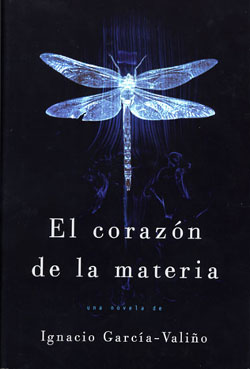
The book tells the story of Lucas Frías, a promising scientist specializing in quarks and subatomic particles, who works at CERN and has sacrificed everything for his career. The death of his partner in a car accident causes Lucas to take a break from his life and while he tries to investigate the causes of his partner's accident, he realizes that he barely knew her.
At the same time, the author places the character in various settings around the world (Geneva, Madrid, Paris, Chile, etc.) and makes him interact and discuss science with such diverse types as psychics, mentalists, ultra-skeptics, and of course, other particle physicists.
The book contains an interesting quote that the author takes from a fable by John Godfrey Saxe and that says the following:
“Long ago, in a forest in Hindustan, four blind men gathered together, claiming to be wise because they could recognize everything through their hands. A student came to visit them to learn from their wisdom, but first he decided to test whether their fame was true. They entered the foliage and the man asked them to recognize what he offered them.
One of them said he had a snake in his hands, because he touched something elongated and moving. The second said he was touching a strong tree with rough bark. The third said it was a rope hanging from a high branch. The last one hit a firm and solid surface, and concluded that it was a wall. They all thought they were right.
The student noticed that the four were wrong, because, touching only the parts, had been unable to recognize the whole. So one had felt a trunk, another a leg, a third a tail, and a fourth the elephant's side..”
The author uses this fable to illustrate the state of Particle Physics, indicating that scientists, like the wise men of Hindustan, try to understand the nature of this branch of science like the elephant in the fable: by fragmenting and breaking it down. In the end, as in the fable, they fail to unify the theories.
Although the author does not state it openly, he is making a clear allusion to the theories of the Weak Nuclear Force, the Strong Nuclear Force, the Electromagnetic Force and the Force of Gravity, which separately all make sense, but there is still no single theory that can explain them together.
The book is entertaining, and the scientific speculations are interesting and treated from a very rational point of view.
The only criticism is that at the plot level, the book is too simple and only develops one story line. At the character level, it is again too simple, and only two characters are given any dimension: the protagonist and his partner.
Still, it's a quick read that leaves a good taste in your mouth. I wouldn't give it a 100% recommendation, but I would give it a 90%.




2 responses
I have always liked physics, I am going to take note of this book.
The effects of the dragonfly always release a different sector in the magnetic field and behave in an unstoppable way.