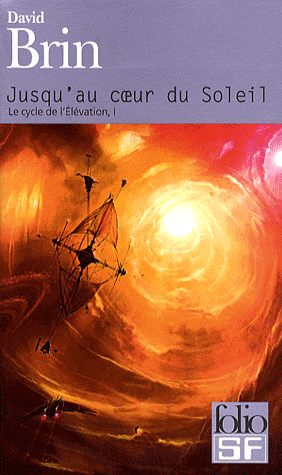
 This review should be called Review of «Jusqu'au Coeur du Soleil: the cycle of Élévation I" of David Brin, because I had to buy it in Paris when I ran out of books due to lack of foresight. Luckily, at the Virgin on Champs Elysees they have a good Science Fiction section and I found this book that I hadn't read (or that if I have read, I don't remember having done so).
I have a little mental confusion about whether I had read it or not, because I am surprised that I have not read it since I thought I had read all the books in the series. Cycle of Elevation (in addition to many other books by this author, including The Postman [the one from the homonymous film directed and starring Kevin Costner] and a prequel to The Foundation Asimov's) but when I read the back cover of this one I realized that I had not read it. And when I read the whole thing, I think for sure that I had not read it. On the other hand, I could consult my library, but it turns out that these books that were written so long ago (this one is from 1980 and I suppose that if I read it, I would have done so around 1988-90) are in the back of the library and I cannot see them if I do not take out a couple of levels that I have superimposed on these. Anyway... a drama. When I am rich I will have a huge library that allows me to read the spines of all the books. Either that... or I digitalize everything I have now. In part, the possible forgetfulness and the lack of facilities for consultation was what motivated me to write these reviews on the blog. At least now I am sure that I remember what I have read these last two years.
But anyway… let’s get to the review of Brin’s book.
Like all the books of the Cycle of Elevation It is based on the premise that humans have made contact with other races in the universe, but it seems that none of these races have reached the stars without the help of a guide race that has helped them rise.
In the case of humans, it seems that no one helped us to rise… or someone helped us, but for reasons unknown to us, left us to our own devices. This causes that both on Earth and off, there are factions that are in favor of one thesis and factions that are in favor of the other, which causes certain frictions between humans, and between humans and extraterrestrials.
The civil organization of our world is curious to say the least, and Brin describes it in detail.
Despite being "orphans," humans are respected by the other races of the universe because they have raised two terrestrial races: dolphins and chimpanzees.
In this particular book, there are hints of a race of strange beings, half energy and half matter, who inhabit the sun. So an expedition is organized to our king star to try to establish contact with this race and eventually discover whether or not it is the one who helped us in the elevation.
The characters are endearing and have depth. The extraterrestrials of the elevated races are very curious and the description of their societies lends itself to dreaming of being able to see them someday. Also the description of the solar ship and the technology it uses to avoid being burned (a stasis generating field that modifies the space-time of the ship's outer shell) is detailed and interesting.
The book is highly recommended, and whether I had read it or not, I am glad I spent a few days of my vacation reading it.