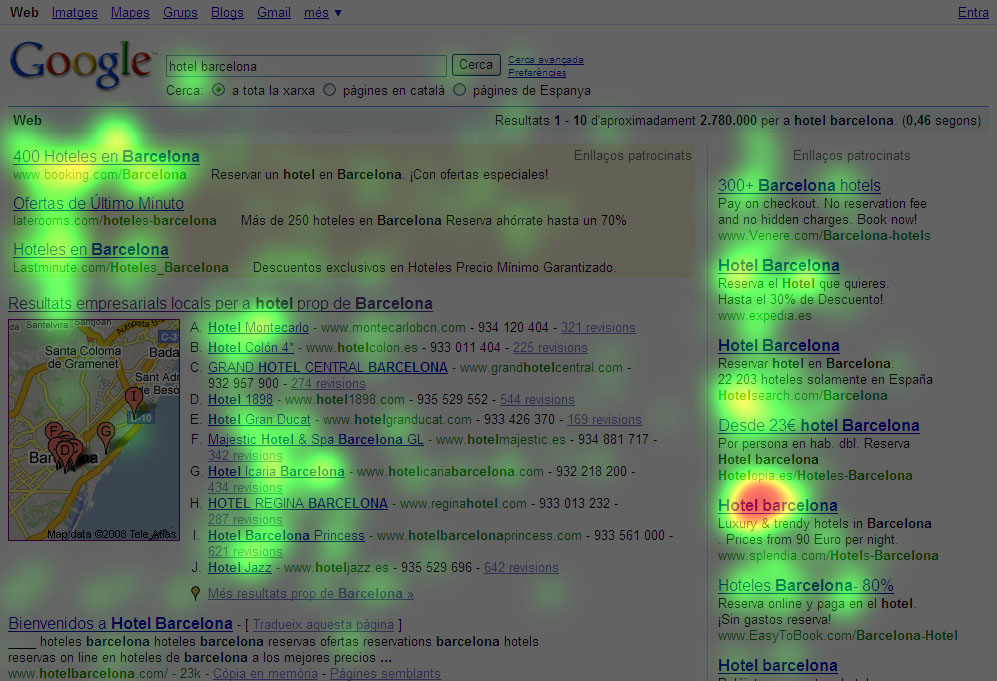
Continuing with the analysis of the Eyetracking tests for the study of Search Marketing oriented to Tourism, carried out during the months of December and January, today we are going to talk about the words that attract attention in the texts.
In the study “Eyetracking Media Spain” carried out by the AIMC and Alt64 In 2005, when I participated in a study on reading patterns in the Spanish online press, we observed that before starting to read a text, the user's brain scans the page they are thinking of reading, looking for words that catch their attention. When the brain finds these words, it decides whether it is worth the effort to read or not.
We have seen the same thing in Google's results pages, and especially with certain Adwords. Let's see:
As I was the operator of some of the tests carried out in December 2008, during the recording itself I noticed that many of the people tested looked at certain ads in particular. Mind you! They didn't click on them, they just looked at them... that is, something caught their attention, but then they continued searching. Obviously, some of them did click on them since most of the ads were related to the search that the user was doing.
If we look at the attached recording (see attached video), we will observe that after reviewing the results page, something catches the user's attention while looking at the Adwords column on the right. There is an advertisement that he looks at up to 3 times. The recording belongs to a user who was being tested in the search for "hotel Barcelona" and his task was to tell us where he would look for a hotel on this results page (SERP=Search Engine Result Page).
We can see that after reading the SERP more or less thoroughly, the user goes on to read the ads on the right and after seeing them all, he fixes his gaze on one of them and then returns to it. It is the Splendia ad. Why does he look at that ad? The user could not tell us why.
Another user (see this other attached video), in the same SERP, he performs the same type of navigation and again he notices the ad… but this time, he also clicks on it. Why does he notice it? Why does he click on it? When asked, the user tells us that it was simply because he noticed it, he liked what it said (and it is in English) and he clicked on it.
But the action of focusing on this specific ad and not on the rest was something that 22% of the users (12 people out of 54) who tested this page did. If we look at the heat map generated by these users, we see that something really caught the attention of the 12 people.
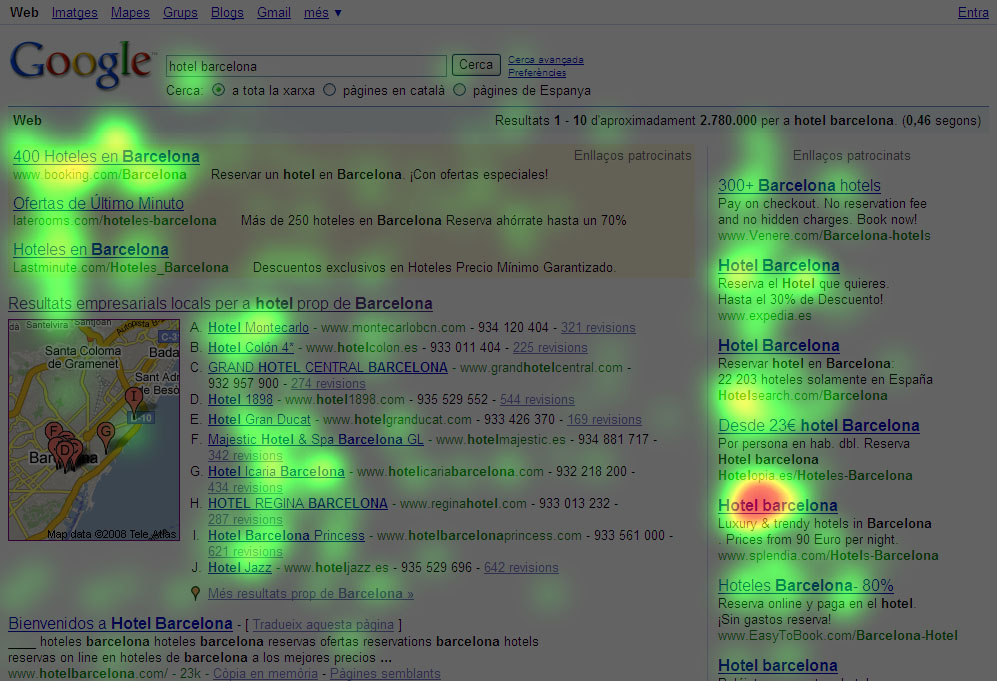
(See attached map showing the aggregate map of the 12 users who fixed their gaze on this point. We can see how it was really an important point in the SERP for them.)
In another task in which the tested users had to search for a hotel suite in Barcelona from the SERP that appears when searching for “suites hotel barcelona”, exactly the same thing happened, but with greater intensity: this time, 37% of users fixed their gaze on a specific ad: the second Adword in the right column. And guess what… it was again the same Splendia ad, which appeared on this page in a different position.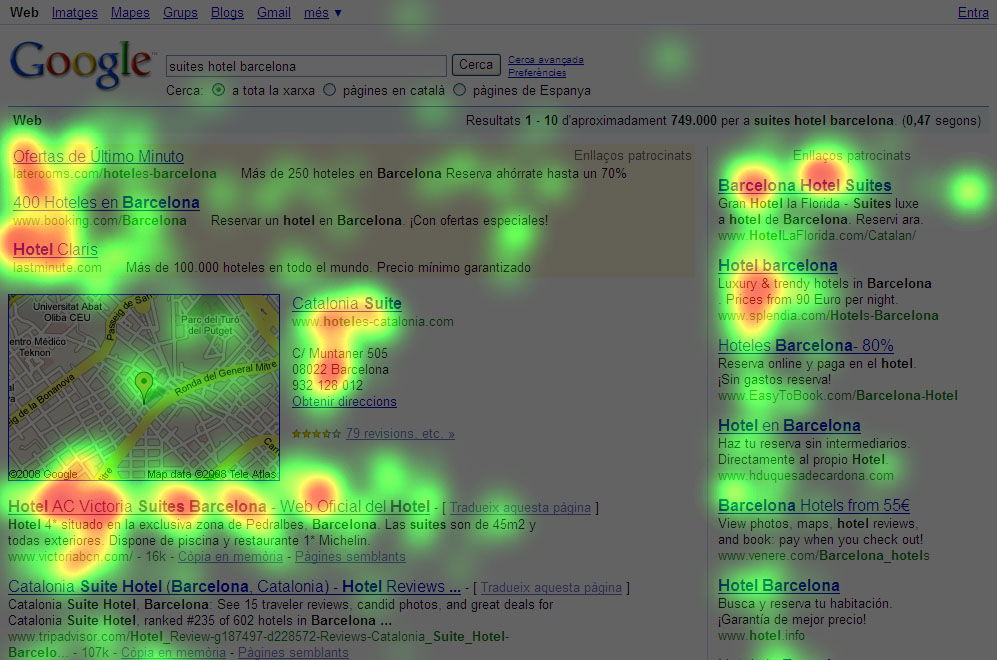
Once again, something caught the attention of users, this time 20 people out of a total of 54.
(See image with the added heat map of the 20 people who looked at the Splendia ad. In this case we can see that the effect is not as devastating as the previous one, but it is still striking that 20 people fix their gaze on this ad, when they are searching for "Suites" and the word does not even appear in the ad)
This “something” that draws the attention of so many users, on different results pages, is the word “Luxury” that Splendia uses at the beginning of its ad description.
In the studio Eyetracking Search Media You can read more about it and find out what else caught users' attention.