

 During this month of October, every Thursday afternoon, I am giving classes on Digital Marketing for municipal technicians in l'Ametlla de Mar (Tarragona). In these classes I explain to the students (municipal technicians in tourism, commerce, sports and members of the city council's communications department) how the Internet works at the promotion level and how to make the most of the tools that the network offers us to make municipal services known to the different segments of their target audience. As in all the classes I teach, I also learn a lot by listening to the students' initiatives and listening to their personal experiences in terms of online promotion. This course has not been the exception.
In one of the sessions we were dealing with Mobile Marketing and among many other topics, we were talking about the use of QR codes and Bidi to relate the offline world with the online world quickly and I explained various initiatives, at municipal and private level, carried out for this purpose.
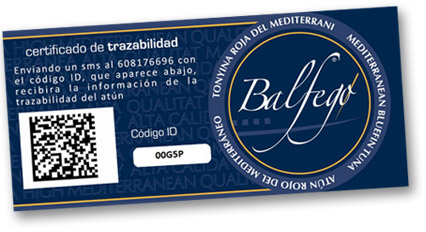
 Well, without me knowing it, it turns out that in l'Ametlla de Mar They are pioneers in the use of two-dimensional codes: In restaurants that serve dishes made with tuna caught in the Ametlla area, along with the dish, you receive a label that includes a QR code (it is the one I show in the first attached image) and a control number that refers to the tuna that has been served to us at the table.
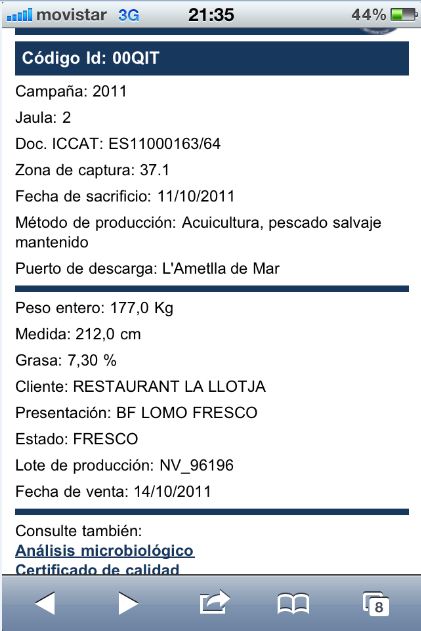
By showing the code to our mobile phone, we can directly access the information sheet for the tuna we are about to eat. The information sheet tells us the day it was caught, the day it was sold, who it was sold to (usually directly to the restaurant we are eating at), the weight of the tuna, and a host of other information about the tuna in question (see the second image attached to this post).
I thought it was a very good initiative!
On the one hand, it allows you to know details about the tuna you are going to eat as soon as you turn off your mobile phone, which you would never imagine. On the other hand, it shows the freshness of the raw material as well as the origin of the piece, so you can appreciate that it is local fishing, and therefore, everything that this implies in terms of sustainability (both social and in terms of environmental ecological footprint). And thirdly, it says a lot in favour of the restaurant and the quality of its gastronomic offer.
So I'm very happy to have discovered this initiative and from now on, I'm going to incorporate this example into my Mobile Marketing classes. I hope that over time it will be something that other restaurants and other food distributors adopt to allow the traceability of their products and at the same time to transmit the quality (in every sense) of the material they offer to their customers.
(This Thursday, when I return to l'Ametlla, I'll definitely eat one of these tuna 🙂 )
We talk to each other
Post noteMiriam Martí has been kind enough to share with me this video that refers to the tuna of l'Ametlla de Mar, in which she shows how the issue of bidis and mobile phones works: Tuna and BIDI
Thank you very much Miriam!
2 responses
Hi Auxy, BIDIs and QR codes are the same thing, but in different formats (it's like when we had VHS and Betamax videos...) they still haven't agreed on which is the standard and each one uses the encoding that seems best to them. At a user level, normally the mobile application that reads QR codes also reads BIDIs (look at images of both on Google Images and you'll see the difference). At a personal level, when I have to encode something I use QR codes... but there is always a rumour that QR codes will be made payable... at the moment they are free and this is the page I use to create them. http://qrcode.kaywa.com/
Hi Montse, your note is very interesting. I was wondering what the difference is between a QR code and a bidi; I have never heard of the latter! It is handled in the same way as the QR.
all the best.