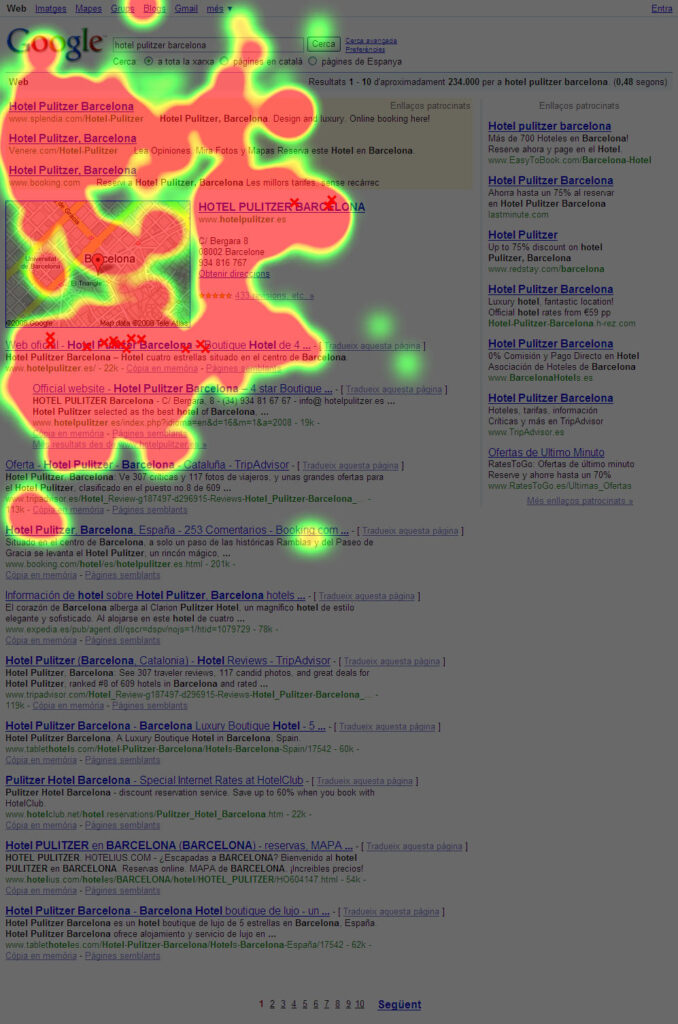
Judging by the headlines published in the press, it seems that this issue is the one that has most concerned the media that have followed our study of Eyetracking applied to Search Engine Marketing.
The truth is that in point 5 of our study we asked ourselves if search engine advertising was still effective, and we concluded that it was, although we indicated as an observation that if in a search for something specific (such as the name of a hotel) we segmented the 54 tests by age, we could see that none of the people in the age group under 25 years had looked at the tests. Adwords sides.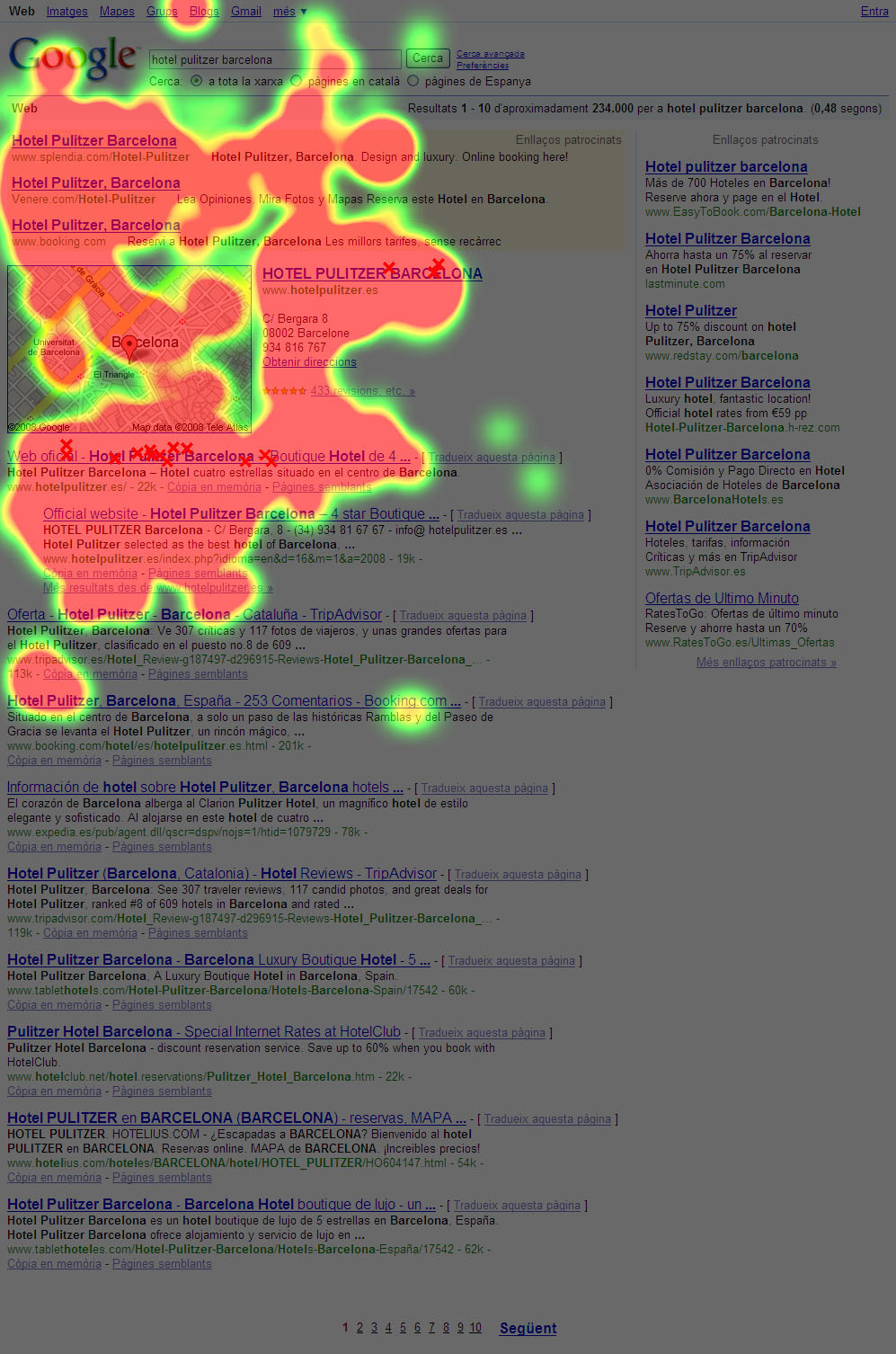
The Adwords The centre-backs were looked at by almost everyone, but the full-backs were ignored by the vast majority of the young people who participated in the study.
When we asked users under 25 why they had not looked at the Adwords sidebars, they indicated that they had not done so because “It's advertising”.
If we look at the image I show next to these words we can observe the phenomenon. In this case, the request was to find the website of the "Pulitzer Hotel Barcelona» and users could find it on Google Maps and in the first SEO result. The heat map we observed is the one built by recording the gaze of all those under 25 years old.
The heat map created from the rest of the users is quite different, and even shows clicks on the side adwords. (See second image)
In the study we also commented on the fact that in many cases young people consider that advertising does not deserve their attention, it was an important topic and it was worth discussing it in more detail on another occasion.
Let's now discuss this in a little more depth.
Theories of Postmodern Communication
These theories base their thesis on the fact that Marketing is so omnipresent in our society (the Consumer Society), that certain groups are beginning to become immune to traditional marketing communications, such as advertising.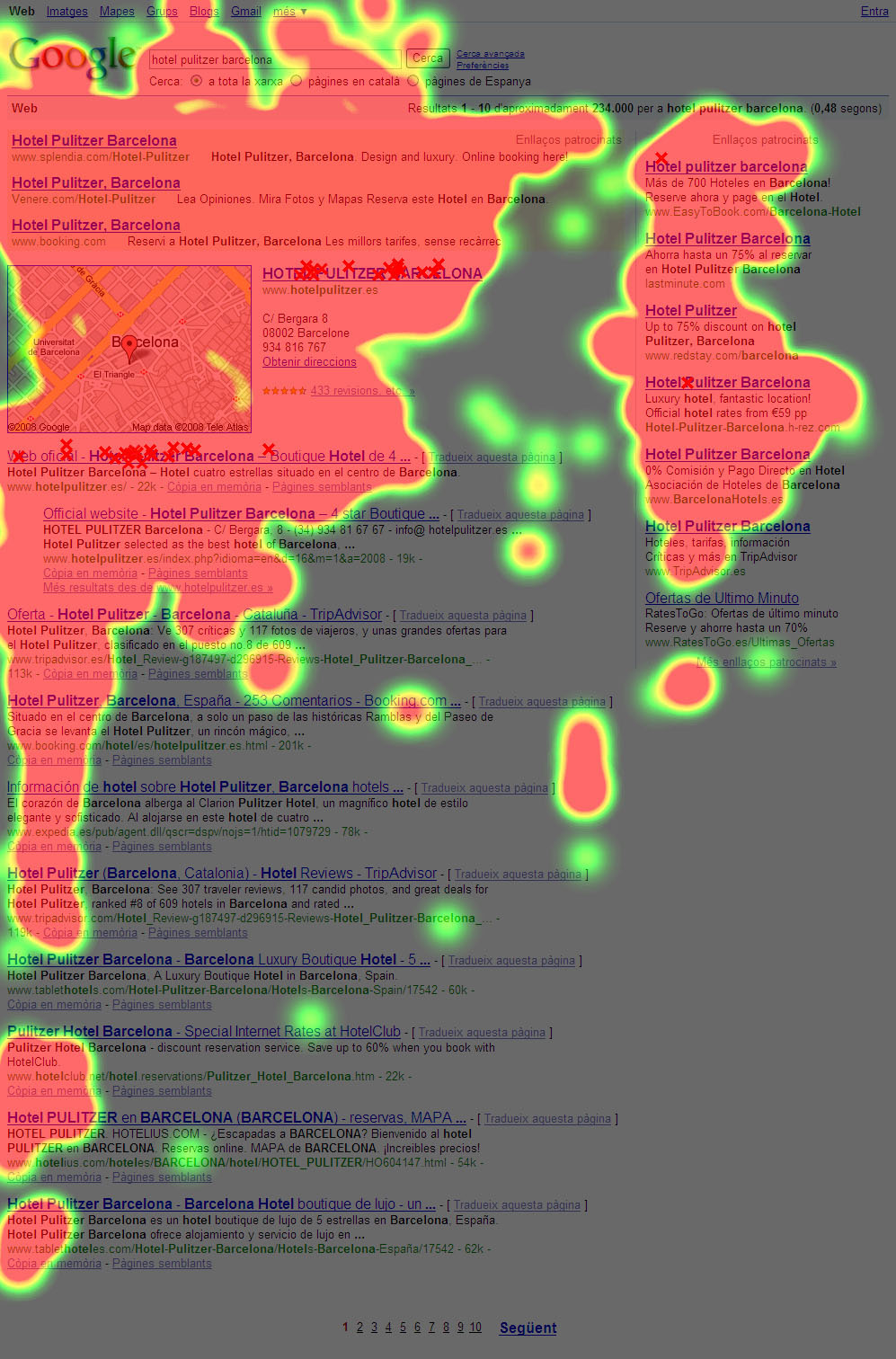
For years we have been concerned about how the large number of advertising impacts that they receive from childhood to adulthood would affect our children (at least, as a mother of 3, it has been a topic of special interest and concern for me). Well... it seems that it was not so bad. The large number of advertising impacts, added to their knowledge of how the Consumer Society works, has made them immune to a large part of the advertising to which they are subjected.
And not only are they immune, but there have even been anti-advertising movements and groups. People who question the consumerist behavior of our society, and some unethical practices of certain companies. The goal of these movements is to recover a life without so much advertising. See for example Adbusters.
Is this the end of the “Marketing era”?
No, of course not. It is only the end of some marketing activities, including some types of advertising.
Philip Kotler in his “10 Principles for New Marketing"It is based on the premise that Marketing as we know it is finished due to the saturation of Marketing and Advertising communications that we receive, and it has to evolve into something much more in line with our time, in which the immediacy of information and total segmentation have changed our consumption habits.
The truth is that marketing is so important in our society that, as consumers, we are increasingly knowledgeable about this subject. The implication of this is that consumers are now very well educated in marketing and advertising campaigns, public relations, direct marketing, etc. And therefore, they know all the tools and techniques used in communications to attract their attention, which to a certain extent makes them immune to them.
This means that marketing professionals have to look for new forms of communication to get their messages across. This is Postmodern Communication, and the Internet has a good field for expansion.
Are they the Adwords a form of Postmodern advertising?
The term postmodern was coined in the 1970s and refers to a type of society in which there is a lack of predictability and an erratic vision of the world around us, as opposed to a world based on science, objective knowledge, universal laws and logical reasoning, which was the basis of the “modern” world.
Applied to Marketing, this term refers to a type of communication aimed at satisfying consumer habits at an individual level, the importance of brands when making a purchasing decision, the importance of ensuring that individuals do not feel like normal consumers, and the growing intrusion of advertising in all areas of our lives.
Since, unfortunately, for a large part of society, what we consume comes to define who we are, from the point of view of advertisers it is extremely important to get their messages across to each individual, however difficult it may be. This is why new types of advertising and communication of marketing messages are emerging.
In this sense, the Adwords, can be considered Postmodern Communication if we take into account that they can reach an almost one-to-one segmentation. Also in the sense that they interfere in many of our activities on the Internet (when reading the online press, when consulting a search engine, when watching videos, etc…). So the answer to the initial question is “yes”, the Adwords can be considered a form of postmodern marketing communication.
Does being a postmodern communication make them more effective?
The Adwords They are still an advertisement that is easily identifiable in many cases. And therefore, as we have seen in the heat maps, users are able to detect and classify them as advertising, which reduces their effectiveness, especially if they are located far from information that is relevant to them. Hence, the Adwords centrals are more effective than the Adwords sides.
As for saturation, in this study we have been able to verify that, indeed, the younger segments of our population are beginning to be saturated with advertising and have become immune to it. Everything they consider advertising is no longer of interest to them. If they can, they do not even look at the areas where the advertising is.
We have even seen that some of them go so far as to consider the results of Google Maps as advertising and do not look at them either. Fortunately, this is not always the case, as we can see in the first heat map we have shown. The map, which I recall again, only corresponds to users under 25 years of age.
Those over 25 did look at the side advertisements, as can be seen in the second map.