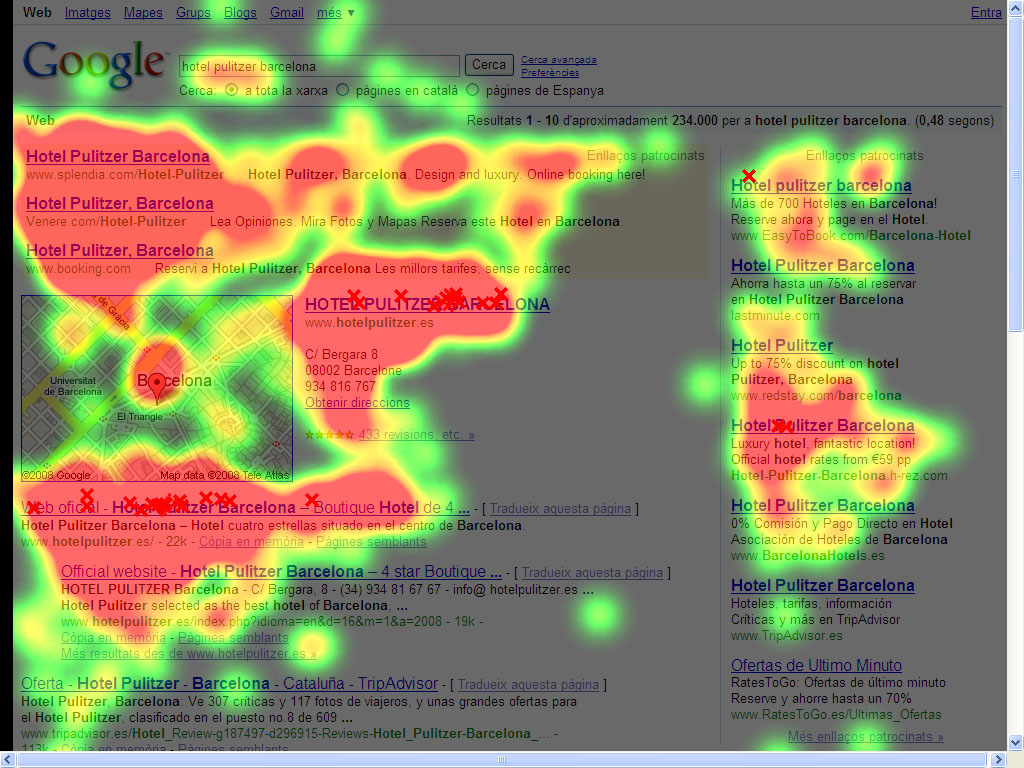
During the months of December and January we have been carrying out a whole battery of tests to prepare a study of Search Marketing oriented to TourismThe tests for the study were carried out using Eyetracking technology and a personal interview once the test was finished, to find out where the tested users looked and why they looked there and not somewhere else.
In total, 54 people between the ages of 16 and 68 were tested.
The results have been very interesting and I will publish them on this blog as we progress in the analysis of the data.
The first of the curious things we have observed is that While appearing on Google Maps is important, it is still more important to come out first through natural positioning.. Especially in specific searches. In general searches of the type "hotel in barcelona«There is no doubt about the importance of appearing on Google Maps. In this post we will analyze specific searches.
Let's see why we have come to this conclusion:
One of the tasks that users had to carry out was to find the website of the Hotel Púlitzer in Barcelona among all the results that appear on Google when searching for “pulitzer hotel barcelona” (without the quotes). 234,000 results appeared.
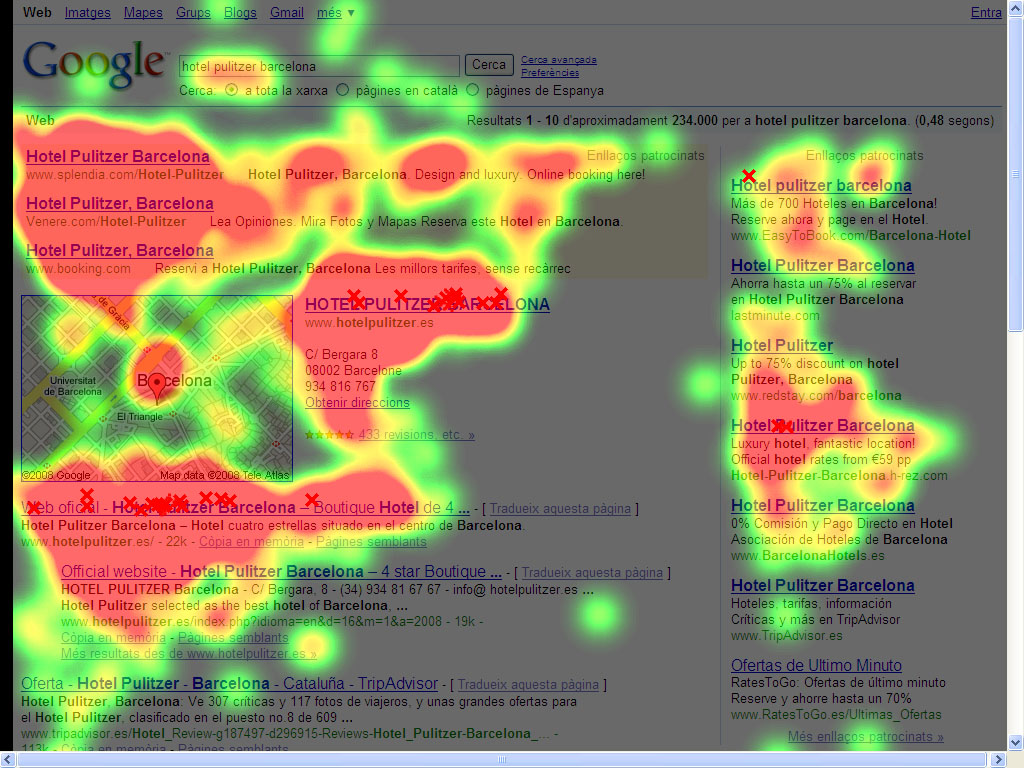
If we look at the heat map image that I show next to these lines, we can see that the hotel's official website appears both on Google Maps and in the first position by natural positioning. Well:
- 51,85% of users clicked on the first natural positioning result.
- 40,74% of users clicked on the website that appears on Google Maps.
- 7,41% of users (4 people) made a mistake and clicked on Adwords or other natural results, convinced that they were clicking on the hotel's website.
When we asked why they had clicked where they had clicked the answers were as follows:
- Those who had clicked on SEO results indicated that they trusted these results more. In fact, 22% had not even looked at the Google Maps area and had gone directly to the SEO area. When asked why they did not trust it, most indicated that they thought it was advertising and that they knew that the results that follow the map are not advertising.
- Those who clicked on the map indicated that they clicked on the map because it appeared in the middle of the screen and that they immediately saw that it was the hotel's website.
Most people indicated that the hotel URL was what told them it was the hotel's official website (Obviously they called it the “hotel address”, not the URL, I write URL to make it easier to write this post). A 25% indicated that the fact that the title of the result indicated “Official Website” had also confirmed to them that they were right and that this was the official website.
- The 4 people who made a mistake and clicked on other results were convinced that they had made the right choice and had found the correct website (until they saw the website they landed on after clicking, of course, at which point they realized their mistake.). In most cases it was the URL that misled them and made them believe they were on the correct result. The URLs they clicked were of the “Hotel-Pulitzer-Barcelona.h.rez.com” hence some people were confused. Although the titles of the ads also helped to confuse them: “Pulitzer Hotel Barcelona» as a title for an Adwords is capable of confusing anyone if other parameters are not taken into account.
As for Adwords in general, almost everyone looked at the 3 ads that appear highlighted in the top area at some point (only 25% did not look at them), as for the Adwords on the side, they were not so lucky, and only 22% looked at them.
In another post we will analyze the topic of Google Maps vs SEO again, but using an example in which the results offered by the page in both cases are different (I'll tell you in advance... SEO wins again).
Post note: You can download the study here: Eyetracking Search Media .