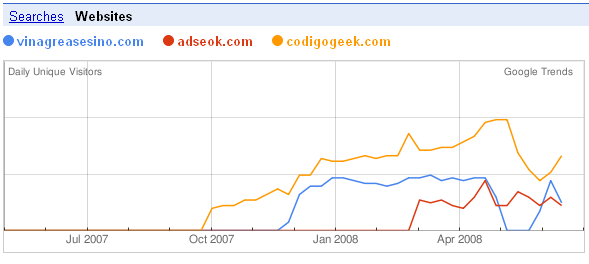
Google has just introduced the new version of Google Trends, which allows you to find out about search trends for websites.
As in the previous version of Google TrendsGoogle allows you to know the percentage of searches, the origin of its users and the language of their browsers. It also allows you to compare up to 5 different searches. But this time, it is not satisfied with presenting data about searched words, but rather it tries to ensure that if these words refer to the domain name of a web page, the information it shows us as a result also refers to possible traffic from Google to this web page.
Let's not kid ourselves, these are not data like those of Alexa or those of Nielsen NetratingsThey only reflect search trends, so if, for example, we try to compare Google Trends traffic vs. Yahoo vs. MSN, we will be disappointed, since we only get data about what people search for… and who searches for Google on Google?… so we cannot extrapolate this information for purposes that could be useful. In addition, Google has indicated that it will not provide data on searches for some of its businesses (it has not said which ones).
However, the information it provides is useful for certain marketing activities, for example, when it comes to learning about the profiles of people who perform certain searches.
For example, we can perform a comparative search for the main social networking sites: Orkut.com, Facebook.com and MySpace.com, and analyze their search by country, which will give us indications about which networks are most popular in each country, and therefore allow us to better plan our actions on these websites.
http://www.google.com/trends?q=orkut.com%2C+facebook.com%2C+myspace.com%2C+xing.com&ctab=0&geo=all&date=all&sort=0
Where does Google get its data from?
According to Google in its information document on the subject
(http://www.google.com/intl/en/trends/websites/help/index.html)
Google Trends combines data from your searches with data from Google Analytics, adds data taken from surveys of Internet users and includes information from market studies (or at least that's what Google says). All this data is integrated into Google Trends using an algorithm known only to Google and without using personal information that allows the identification of the users about whom the data was obtained.
According to Google, it updates the data every 30 days.
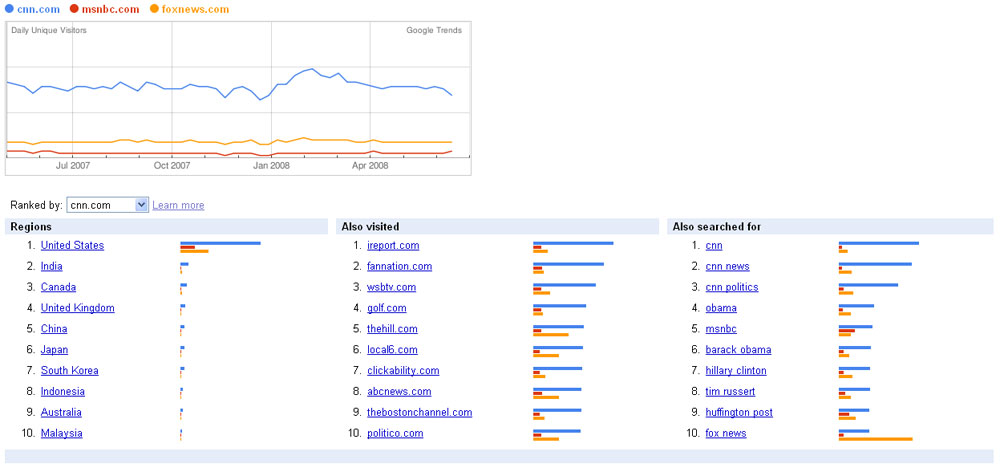
Not all websites appear in Google Trends
As in the previous version, data is only provided for searches with a lot of traffic, so there is no need to worry if you do not appear in Google Trends. Google has not stated at what number of searches or what figures you need to reach to be visible in Google Trends.
It will certainly be interesting to play with this version of Google Trends. A priori, it will have its uses, although as I mentioned at the beginning of this article, one must be careful when analyzing the results.