
How to create a Digital Communication Plan
Communication on the Internet has changed a lot in recent years. The massive entry of companies into the network, coupled with the entry of new users caused by COVID-19, requires digital marketing professionals to be up to date and carry out their plans using the strategies and techniques that really work. Digital marketing is a discipline that is in full expansion, but also in full change and evolution.

This week, I have had the pleasure of teaching three monographic workshops in Andorra on SEO, advertising and web analytics, respectively. And a face-to-face course dedicated to the creation of an Online Communication Plan for tourism companies.
I am writing this article, not to talk about the course, but to talk about the methodology I use to help create digital communication plans. I would like to share with you the framework we use at the UNWTO, the United Nations agency responsible for helping countries develop through Sustainable Tourism, to help companies and destinations create their online communication plans… in case it can help you prepare yours, whether you are in Tourism or not.
That said, let’s get to the framework that will help you create the plan. It’s called SOSTAC, which stands for Situation, Objectives, Tactics, Action, and Control.
Points of a Digital Communication Plan
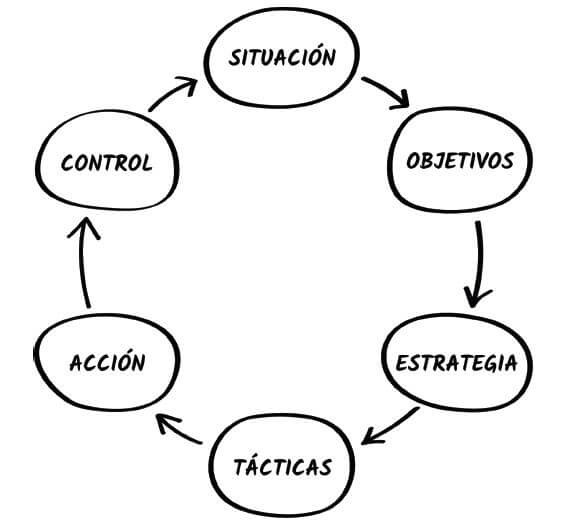 Creating a Situation Analysis
We will carry out a brief analysis of our organisation to remember what our mission was when it was created, what our values are and what our business model is. We will also analyse current types of clients, what our competition is doing on the Internet, industry trends, etc. With all this information, the company will create a SWOT. With the SWOT in hand, a CAME will be created (it will define actions and strategies to neutralise the negative points and will highlight and enhance the positive points of the SWOT).
If you want more information about doing a SWOT or a CAME, I have put some links at the end of the article.
Setting realistic goals
We will define clear, measurable objectives based on current numbers. To create objectives, it is best to start by creating a sales funnel to find out the current conversion rates, and from this data, to be able to set realistic objectives.
Defining our digital strategy
We will draw up a strategic plan defining customer, price, marketing, communication and brand strategies.
In the bibliography you will find an article of mine where I explain in more detail how to create digital communication strategies.
Identifying the best tactics
We will plan the tactics that will help us to get customers to us automatically and sustainably. Inbound marketing and content creation will be our main tactics.
Creating the Online Action Plan
We will define a whole series of actions to achieve the objectives we have set ourselves. Actions to attract traffic to the website (SEO, SEM, advertising on networks, natural presence on social networks, presence in online media, presence in online markets and direct marketing [email marketing or Whatsapp marketing]). Actions to convert visitors into customers (persuasion, trust and good user experience [UX]). And actions to build customer loyalty.
Controlling the Online Communication Plan
We will create a measurement and control plan to ensure that the actions are leading us towards the proposed objectives. We will define KPIs (Key Performance Indicators) and we will use some data visualization tool to easily interpret the data (we can use the dashboard of Google Analytics, or use Google Data Studio and thus be able to add data from more than one source).
All of these points are the ones you should work on step by step, so that at the end of the process you have an Online Communication Plan that guarantees you achieve the strategic objectives you set for yourself, and an action plan that allows you to avoid having to improvise.
You will find more information here:
- Article that will help you define communication strategies: The 6 marketing communication techniques applied to the Internet.
- Here I explain to you How to calculate website conversion ratesYou will need it for the sales funnel and for setting goals.
- Article in which Hubspot explains how to do a SWOT. This article also explains how to apply a CAME, although it is not called a CAME analysis. It also includes templates and examples. It is very well explained, I highly recommend it to you.
- Book in which I explain how to make a digital communication plan: Guide to creating your online action plan.
- Link to the article of the Andorran Government talks about the course.
I hope this article helps you.
As always, receive a big hug.
We're talking.