Business Model Adaptation in the Cultural Sector
The magazine “Journal of Open Innovation” has published an article in which, together with Francesc Miralles, we analyse how Spanish cultural companies have adapted their business models during and after the crisis caused by COVID-19.
You can find the article here: Adaptation of Business Models in the Cultural Sector in Spain
As it is in English and is also academic, I am making a summary below these lines, in case it may be of interest to you.
The aim of the research is to find out how cultural companies have adapted their business models during the COVID-19 crisis. Knowing more about this adaptation is important to ensure that both the cultural sector in general and companies in particular are more resilient in the future and also to understand the various adaptation mechanisms they have used.
Observations made during the investigation
1) Certain companies did not adapt. Some companies did not adapt their business models for various reasons: either they did not believe it was necessary and had enough financial muscle to wait for “the storm to pass”, or their managers had the perception that adaptation was impossible and prepared to resist or they dedicated themselves to other jobs.
2) About the adapted components: Companies that adapted did so by changing some of the components of their business model (sequential adaptation) and very few did so in a radical way. To learn about the adapted components, please see the article.
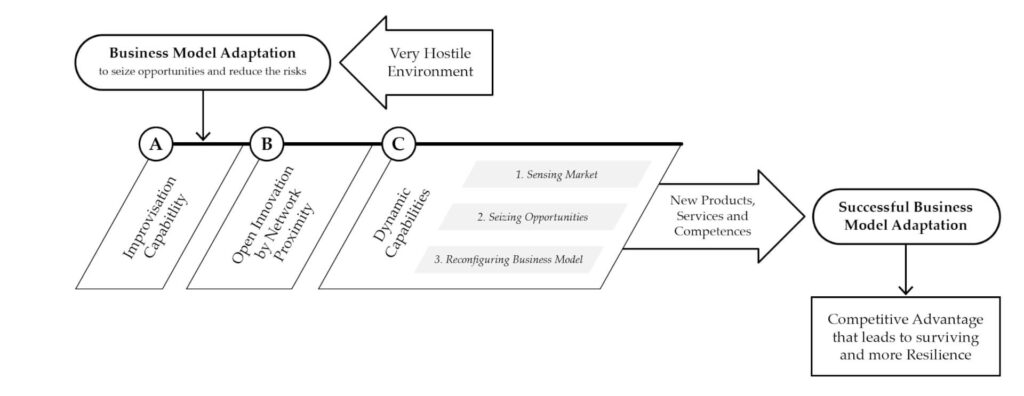
3) Phases of adaptation: The companies that adapted did so in 3 phases, the first being improvised adaptation, in which they had to respond to the emergency with the technical, human and knowledge assets they had at that time, while planning medium-term adaptation.
4) The role of institutions. The organisations that have supported cultural companies during the crisis have played a fundamental role both in providing moral support to the people involved and in transmitting the innovation needed to adapt. Without them, the dissemination of innovations would have been very difficult.
In summary
To better understand the adaptation of the business models of cultural companies, we must analyse their capacity for improvisation in the face of an emergency, their connection with institutions and organisations that bring together their peers, and their ability to detect the changing needs of their clients and create a medium-term plan to meet them.
Again, if you want to know how the adaptation was carried out, or you want to know more about the research or the methodology used for this specific work, I invite you to read the article: Adaptation of Business Models in the Cultural Sector in Spain
New research on business model adaptation
The research I am currently carrying out is still on cultural companies, but I am analysing whether when an emergency such as COVID-19 occurs and business models need to be adapted, the sustainability of said models continues to be taken into account… Or, on the contrary, the survival of the company takes precedence over any other consideration.
How do you see it? What is your opinion?
We talk to each other!