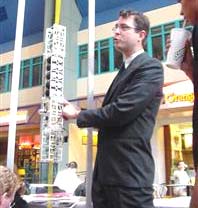
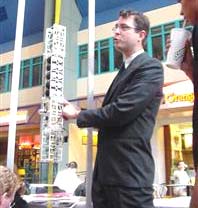
 Taking an elevator into space may sound like science fiction, but the first prototype of a space elevator is being built in Seattle.
The truth is that although the image that many of us have in our heads is similar to a more or less common elevator, the reality that scientists are working on is a little different. To begin with, they are not working with a cable but with a wide belt, made of carbon nanotubes... rather, something similar to a monorail or a rack.
…And this is what they are working on in Seattle.
LiftPort Group has a $570,000 grant from NASA to build the project, as well as funding from private investors and a business plan that is based on generating revenue from the first year of research.
What a space elevator looks like
The concept is simple. The elevator is basically a cable, tied at one end to a platform, which can be floating at sea or on land.
At the other end is a satellite, in a 35,000 km orbit floating above the Earth.
Cargo, such as parts of a space station or humans traveling for pleasure, is catapulted up the cable and into orbit at a fraction of the current cost, since gravity does most of the work by coordinating the loading and unloading of material.
How it's being built: A new business model
The LiftPort company is divided into several smaller companies, each of which tackles a different aspect of the enormous engineering work involved in building an elevator. There is one company that is dedicated to finding the best way to build the nanotube belt and to researching the essence of the belt, another that works on the propulsion of the elevator shaft and on the shaft itself… there is also a company that is dedicated to promoting the elevator and another that manages the funds.
The work of each of these companies will lead to the invention and commercialization of many other devices that will be useful to other industries. For example, it seems that as a result of their research they have come up with a new way of doing aerial surveillance, and also a new type of antennas that float on balloons and that would allow for large wireless networks.
So it is clear that LiftPort's business model is based on obtaining financing by marketing everything that is invented along the way. Because we must remember that LiftPort is not a company of scientists (although there are some...) but an engineering company... and an engineer, a scientist and a salesman... form a trio that in the hands of a financier generates good expectations, to say the least.
Images of the first model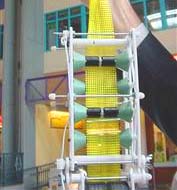
The images illustrating this article are of a robot called “Squeak,” which is capable of climbing a plastic conveyor belt. This robot, on a different scale, appears to be quite similar to the future space elevator, and according to Michel Lane, President of Lift Port Group, the team working on the elevator shaft propulsion, it is using Squeak as its basis.
One of the novelties of this robot is that it is propelled by a laser beam sent from the base on Earth and which collides with a platform located on one side of the robot, making it move forward.
The keys to the space elevator
…But back to the elevator: the three technical pillars for the manufacture of the elevator, and what LiftPort is working on, are:
- A robotic transport that can withstand both the pressure at sea level and working more than 50,000 km above Earth. The questions: wheels? rails? cables?
- Find a super-strong material that will not collapse under its own weight when it is 100,000 km long.
- Find a power source for the robot. Solar power? Batteries?
If an elevator is built that solves these three technical pillars, it will also be possible to build a variant of the elevator that would put NASA's shuttles out of action... since with some modification, the robot and the conveyor belt could launch the material and propel it into orbit around Mars or any other planet. Once in that orbit, another space elevator could lower it to the surface. And vice versa... from Mars, materials could be sent to Earth (...this is already starting to sound like Kim Stanley Robinson in "Red Mars" Ed. Minotauro).
Universities are also involved in the project
Michael Lane has been giving lectures and seminars at various universities in the Seattle area, trying to get a large number of students to do their PhD theses on elevator-related technologies.
And as expected... an American magnate has already appeared and created the “Elevator: 2010” that will reward innovations in the development of Squeak-type robots, as well as belts made of super-resistant materials and propulsion systems that are viable for the elevator.
The elevator is indeed a very attractive project, with a lot of fame and money attached to it. The company that puts the first space elevator into operation will undoubtedly have a strong advantage over its potential competitors. It is expected that there will be up to 10 space elevators in the next 20 years. The bad news is that no elevator is expected to be completed in the next 5 years, rather it is expected to be built between 8 and 10 years from now…
… “Patience is the mother of science.”
The first date for “Elevator: 2010” will be in June 2005 and the prize will be $50,000… so if you are an engineer and you like gadgets that can help create the first space elevator… you know what to do…
Interesting links for those who wish to obtain further information:
- If you want to participate in the «Elevator: 2010», this is your website:
Elevator: 2010 - If you want to know more about how the elevator works, here is the website of the company that is building the elevator:
LiftPort Group