
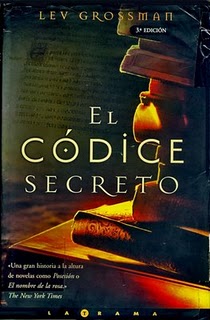
 I have a lot of reviews pending, so I'm going to take advantage of these holidays to catch up. Today's review is about a technological thriller set in a world of [slightly weird :-)] video game programmers and [also slightly weird :-)] librarians.
The plot of the book puts us in the shoes of Edward Wonzy, a young banker from New York who has just accepted a transfer to London, but before his departure, the company he works for asks him to organize and categorize a private library. (Here I was almost ready to put the book down: a banker acting as a librarian on behalf of his company? It makes no sense… later you end up understanding that this is already part of a “conspiracy”… but I confess that since I had bought the book in a supermarket [I bought it in the summer and the bookstores in the town where I was didn’t have Science Fiction] I had prejudices about the possible plot and about the quality of the book.)
So it turns out that in one of the books that must be catalogued there is a steganogram (a message encrypted in such a way that it hides the existence of another encrypted message, this one much easier to decipher [in principle]). The origin of this message is found in a medieval writer with an unremarkable life. The discovery of the message and its possible publication could affect the reputation of powerful English noble families, so many people are against this happening. Finding the book and deciphering the message will lead our protagonist to interact with video game programmers and expert librarians, each of them described in detail and showing their oddities to make them more interesting in terms of creating a character identity.
The truth is that, as I was expecting the worst when I started reading the book, I was not disappointed by the fact that the book itself is weak and “light” (in the sense that it does not make you think or raise any questions that interest me), but it is readable and serves its purpose as a weekend escape. In addition, the author pleasantly surprised me when describing the dive where the programmer he has to interact with lived, he indicates that “The walls were papered with posters of the Mandelbrot diagram reproduced in psychedelic colors”. Yes sir! A good 80s-era freak must have a Mandelbrot diagram hanging on his wall. Good description.
 I don't have one, but I confess that fractals have always fascinated me. In fact, my passion for programming began when I discovered at the age of 13 that when I substituted the variable for a random number (random), I got beautiful drawings on the screen of my ZX-Spectrum. In my head, maths stopped being something abstract and became something visual and beautiful (…naive me). When I got to university and had to study concepts like Ker, kernel, Rank… in algebraic functions… unfortunately, they put me back in my place and I never recovered :-).
But returning to the Mandelbrot diagram (it is the one I show in the attached image), precisely Benoit Mandelbrot, the mathematician who created the theories on fractal geometry, died this past October 10, 2010 and some media outlets echoed it and explained some of his work. Through this review I also wanted to pay him a small tribute.
Here is the link to his Wikipedia page in case anyone wants more information: Benoit Mandelbrot
Here is a 17-minute lecture given by Mandelbrot himself in early 2010 (it's very interesting): TED – Mandelbrot
To see beautiful fractal images created from Mandelbrot's geometry studies, follow this Google Images link: Mandelbrot images




One Response
With how well you write, I feel like buying it and reading it.