The Last Day of Creation It is a book that is really worth reading: it is entertaining, with an original plot, it gives a different view of Atlantis and it is pure time travel science fiction.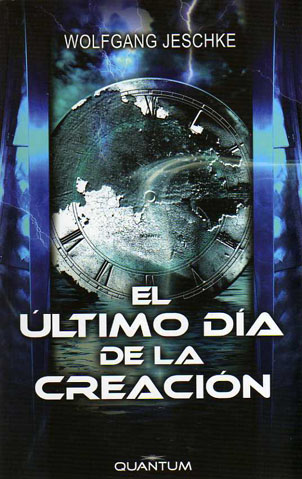
As for the author, as the title of this post indicates, it is Wolfgang Jeschke, an internationally renowned German author, but I confess I was not familiar with him and therefore had not read anything by him before. I will have to remedy this.
The book begins by narrating different episodes in which strange objects are found near the Mediterranean basin, which although they seem to come from a very distant past, are made of materials that have only recently existed, or in some cases, that have not yet been invented.
It also explains how some of these anachronistic objects end up being venerated as relics by Christian tradition.
A second part of the book takes place during the 1980s (when the first edition of this book was written) where we have NASA and the US Navy who have just discovered that it is possible to travel to the past.
The third part of the story is set in the distant past in which the only Homo sapiens sapiens are those who have arrived from the future... although not only those from our timeline.
With reference to Atlantis (I keep reading books that talk about it), he places it in Bermuda and it is a refuge for men who have traveled to the past and have been stranded in time. In this way he explains both the strange phenomena that were so popular in Bermuda last century, as well as the origin of the legend of Atlantis. The explanation is quite convincing.
The book reads well and is engaging, so it can be read in three or four days with some free time.
There are just a couple of negative things… and they are not the author's fault, but I'm afraid it is the translator's work:
- In several chapters of the book the theory of the Plate Tectonics and instead of writing “tectonics” the book states “Teutonic” but not once (that could be considered a typo) he does it several times, in different places and with variants of the word. So as the author is German and the plates are “Teutonic”, when the book indicates that “There are strong Teutonic movements in the border area of the Mediterranean basin"It's a bit funny to imagine a whole group of Germans moving around the Mediterranean basin and shaping the relief.
- The other is vocabulary… the author refers several times to a ship with a lateen sail sailing in the Mediterranean. The captain of the ship indicates at different times that when sleeping or resting they should “tie the oar”. The author is referring to the tiller, which on lateen-rigged ships looks quite similar to an oar, but it is not an oar, it is a “cane”. I don’t know what the author wrote in German…
These two anecdotes do not mean that the book is 100% recommendable and worth reading and spending a good time thinking about paradoxes, anachronisms and different timelines.